


In the paper-and-pencil (P&P) ASVAB, every examinee is given the same items, regardless of his/her ability level.
In order to accurately measure ability across all examinees, the P&P-ASVAB includes items that range from very easy to very hard. However, administering easy items to high-ability applicants is inefficient. Usually, high-ability applicants answer these items correctly so these easy items provide little information about high-ability applicants ability levels. The same inefficiencies are true for administering hard items to low-ability applicants. The most accurate measurement occurs when the difficulty of the items is matched to the examinee’s level of ability.
In the CAT-ASVAB (computer adaptive test), the test is tailored to each examinee. Items are selected for administration from a pool of items that range in difficulty from very easy to very hard. After each item is administered, information is collected and evaluated, and the item best suited for the examinee’s estimated ability level is selected to be administered next. This adaptive item selection process results in higher levels of test-score precision and shorter test lengths than the P&P-ASVAB.
Test Lengths

The figure illustrates that shorter test lengths can be achieved on the CAT-ASVAB by tailoring the test to the ability level of each examinee.
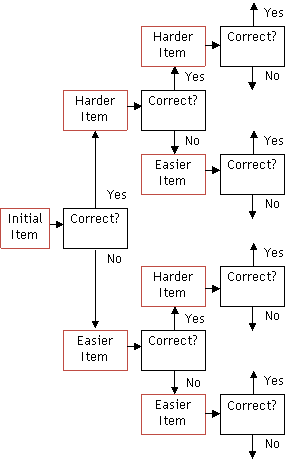
Typically, if an examinee answers an item incorrectly on the CAT-ASVAB, an easier item is selected to be administered next. If an examinee answers an item correctly, then a harder item is selected to be administered next. The item selection process for the CAT-ASVAB is illustrated in the flowchart.
The branching used in the CAT-ASVAB ensures that examinees will be administered items best suited to their abilities. The item selection process is repeated until either the test is completed or time runs out. At the end of the test, a final score is computed from the applicant’s responses.
Time Limits
A penalty procedure is applied to all examinees who do not complete the test before time runs out.
This is done by scoring the items that were not completed as though they were answered at random. In almost all cases it is not necessary to apply the penalty, as the time constraints are liberal enough that nearly all examinees are able to complete each subtest.
| Subtest Time Limit (in minutes) With or Without Tryout Questions | ||||
|---|---|---|---|---|
| Subtest | Number of Scored Questions | Number of Possible Tryout Questions | Subtest Time Limit Without Tryout Questions | Subtest Time Limit With Tryout Questions |
| General Science (GS) | 15 | 15 | 12 | 25 |
| Arithmetic Reasoning (AR) | 15 | 15 | 55 | 113 |
| Word Knowledge (WK) | 15 | 15 | 9 | 18 |
| Paragraph Comprehension (PC) | 10 | 15 | 27 | 75 |
| Mathematics Knowledge (MK) | 15 | 15 | 31 | 65 |
| Electronics Information (EI) | 15 | 15 | 10 | 21 |
| Auto Information (AI) | 10 | 15 | 7 | 18 |
| Shop Information (SI) | 10 | 15 | 6 | 17 |
| Mechanical Comprehension (MC) | 15 | 15 | 22 | 42 |
| Assembling Objects (AO) | 15 | 15 | 18 | 38 |